
Some of the most frustrating career stories in software share a shape: a genuinely strong engineer, a real track record, and a resume that keeps getting screened out before a single conversation happens. The instinct is to blame the market or the applicant-tracking software. Usually the problem is smaller, more fixable, and completely invisible to the person it’s happening to. That gap is why we built a free AI resume analyzer built for engineers.
The problem we kept seeing
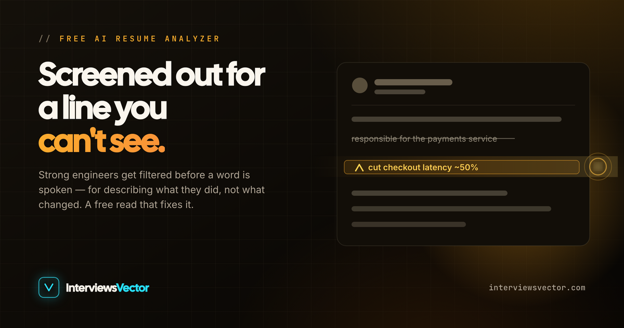
The single most common failure on an engineering resume is describing responsibilities instead of impact. Bullet points read like a job description — “responsible for the payments service,” “worked on the checkout redesign” — every word true, and almost none of it useful to the person reading it. Those lines describe what an engineer was near, not what changed because they were there.
Senior engineers are especially prone to it, ironically because their work is so complex. The harder the project, the easier it is to hide behind vague phrasing and assume the reader will infer the significance. They won’t. A hiring manager’s first pass is a skim measured in seconds, and nobody does the work of translating “involved in” into “drove a result.” That translation is the candidate’s job, and skipping it is what filters strong people out.
Why a tool, and why AI
You cannot see this problem in your own resume. You know what you meant, so the missing impact reads as obvious to you and invisible to everyone else. That is precisely the blind spot a second reader fixes — but a good, honest second read is exactly what most people don’t have reliable access to.
That is the kind of task AI is genuinely well-suited to. Not writing your resume for you — an AI-written resume reads like one, and interviewers can tell — but reviewing it: flagging responsibility-language where impact belongs, spotting buried scope, and pointing out where a reader’s eyes will glaze over. It’s structured, pattern-based feedback available on demand, without the friction of asking a busy colleague for the fifth time. The tool reflects a specific belief: the goal is to make your accomplishments legible, not to manufacture generic ones.
Why we made it free
We could have put it behind a signup wall. We didn’t, for a reason that is partly principle and partly strategy.
The principle: a resume is the gate to the entire process, and getting screened out there means none of the rest — the studying, the practice, the actual ability — ever gets a chance to matter. Helping someone clear that gate is the highest-leverage, lowest-cost thing a preparation product can do, and gating it felt wrong.
The strategy: we build interview-preparation and engineering-reference material, and we would rather earn trust by being useful first. Someone who fixes their resume with a free tool and lands more interviews is exactly the person who benefits from the rest of the interview-preparation product — the system-design material, the practice, the senior-level content. Being helpful up front is a better introduction than a paywall.
What good looks like
The tool encodes a simple standard: every meaningful line should answer what the scope was, what you specifically did, and what changed as a result — stated in real terms, and in honest numbers where you have them. “Redesigned the caching layer for checkout, cutting page-load time roughly in half and removing the most common source of peak-traffic timeouts” is the same underlying work as “responsible for improving performance,” rewritten to read like a reason to schedule a call.
One rule it enforces throughout: never invent the numbers. A fabricated metric that collapses under one interview question does more damage than an honest qualitative claim. The point is to surface real impact, not to inflate it.
The bottom line
We built a free resume analyzer because the most common reason strong engineers don’t get interviews is a fixable, invisible habit — and fixing it shouldn’t cost anything. Say what you changed, put the senior signal where a five-second skim will catch it, and let a second reader show you the blind spots you can’t see yourself. Clearing the resume gate is where preparation starts paying off, and it seemed like the right place to start being useful.