
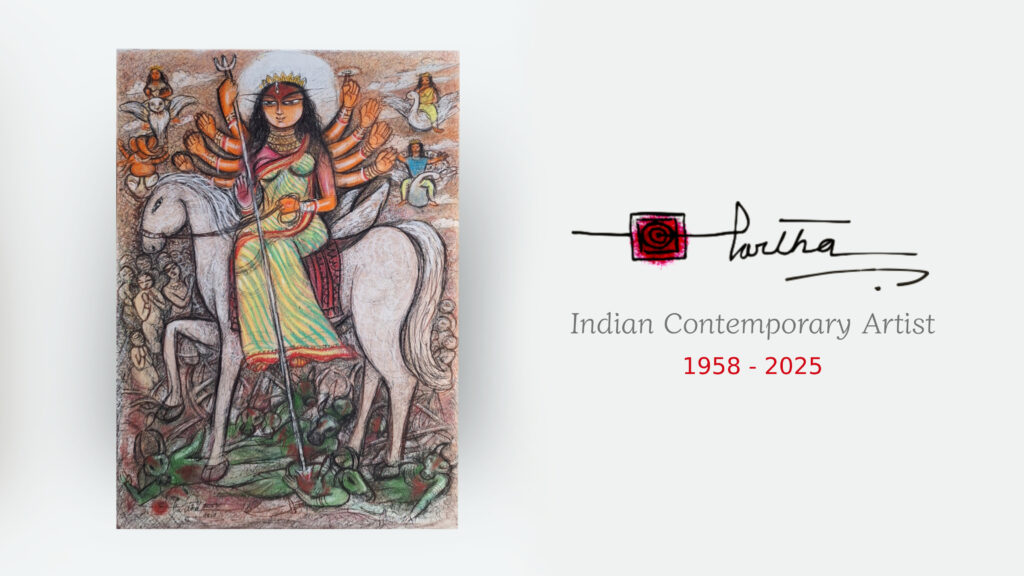
Partha Bhattacharjee, the Indian contemporary artist who spent more than 35 years working in oil on canvas before a 2017 cerebral attack forced a change of medium. His late works — produced in dry pastel and mixed media on paper, in the folk idioms of Madhubani, Warli, Gond, and Bengal Patachitra — are the most personal, most culturally rooted, and in many ways most fully realised paintings of his career.
The change was forced. The result was a gift.
Why Pastel, Why Paper
The cerebral attack of 2017 damaged Partha’s peripheral vision and reduced his ability to focus with precision. Oil painting — the medium he had worked in for over three and a half decades — demands that the artist stand back and survey, assess fine gradations of colour and tone, track the relationship between distant passages of the canvas with steady eyes. His eyes could no longer offer him this reliably. The fine-tipped brushes that had once rendered a silk sari with photographic clarity felt, in his compromised sight, like instruments of frustration.
Dry pastels operate differently. They reward pressure and instinct over patience. A colour can be deposited, blended, modified with a fingertip. For a man whose hands still carried forty years of visual memory — who had internalized the light of India’s villages, the colours of terracotta temples, the eyes of goddesses in Pattachitra scrolls — pastel on paper was not a lesser substitute. It was a different conversation with the same profound subject.
The Folk Languages Released
What the shift to pastel made possible was the full release of decades of absorbed folk art learning. Partha had been visiting India’s most remote villages for years — Shantiniketan, Rampurhat, Tarapith, the Sundarbans, Raghurajpur in Orissa, Ajanta in Maharashtra — sitting with artists who practiced Madhubani painting, Warli art, Gond art, and Bengal Patachitra as living traditions. He had gone to observe and learn.. He had gone because he believed — correctly — that the truest visual languages of India were not in the academies or the galleries but in the villages.
After 2017, these languages came forward. The bold outlines of Madhubani. The geometric figures of Warli. The intricate patterning of Gond. The narrative directness of Patachitra. In Partha’s late works, these are not quotations or homages. They are the natural language of someone who has learned to think and feel in a tongue until it is indistinguishable from his own.
Final Series
The Companion Series is perhaps the quietest of the three major late works — paintings of rural intimacy, of the small dignities between two people or a person and an animal. The Migrant Worker Series carries more weight: the sadness of people who have left their land for the city and found themselves belonging fully to neither. The Rural Series and the Mahakal Series are the most comprehensive, the most culturally expansive — a synthesis of everything Partha had seen and learned and loved across a lifetime of walking into India.
These are not easy paintings in the sense of being decorative or soothing. They ask something of the viewer: to slow down, to stay, to look until you understand what you are looking at. But they reward that patience with something that genuine folk-inflected fine art always offers — the sense of being in the presence of a tradition that is both very old and entirely alive.
Anyone interested in the depth and cultural richness of Indian contemporary art should begin at https://parthabhattacharjee.com/available-indian-and-fine-artwork/ to understand the full arc of Partha’s career, and explore Partha Bhattacharjee’s work from these final years — paintings that prove, decisively, that vision is not made by the eyes but by a lifetime of dedicated, honest looking.